
Abstract
With any communication system the received signal varies from the transmitted signal because of several transmission impairments. Fading is a major impairment when transmitting a signal in wireless communication channel. It is caused by multipath propagation. That is signals from different paths can constructively or destructively interfere with each other. Thus, it becomes very necessary to reduce this effect, to transmit the signal effectively to the receiver. Various channel models are available to transmit data from one place to another. Rayleigh, rician and additive white Gaussian noise) fading channels are commonly used models of real world phenomena in wireless communication. The received signal follows a Rayleigh distribution when there is no line of site between the transmitter and the receiver and it follows a rician distribution if one such path is present. The performance of these channels is measured by calculating the bit error rate versus signal to noise ratio. wireless channel
This paper deals on analyzing the performance of those channels concluded from bit error rate
versus signal to noise ratio plot using a modulation technique which is a binary phase shift keying.
The performances were analyzed and compared using matrix laboratory (MATLAB) Software.
This paper examines fading and it various types. Different techniques being employed to reduce
the effect of fading using Diversity specifically on the maximal combining ratio. This paper concludes that nakagami fading channel has a better performance. Because nakagami fading channel uses maximal combining ratio to reduce the bit error rate under the binary phase shift keying modulation technique
Acknowledgment
First and foremost, we would like to sincerely thank our remarkable and startling advisor, instructor
Ephrem. And also we would like to say thank you for his effort in guidance and motivation to do this project. We also thanks to Mekelle University for its excellent resources and working environment like digital library and wireless communication or Wi-Fi
Back ground information
Communicating data from one location to another requires some form of path way or, medium. These pathways are called communication channels. Use two types of media. These are Cable (twisted pair wire, cable, and fiber optic cable) and broadcast (microwave, satellite, radio and infrared). Cable or wire line media uses physical wires of cables to transmit data and information. Twisted pair wire and coaxial cables are made of copper, and fiber optic cable is made of goals [1].
A communication channel is a type of media that is used to transfer a message from one point to
another. A channel is used to convey an information signal. For example a digital bit stream, from
one or several senders or transmitters to one or several receivers. A channel has certain capacity
for transmitting information, often measured by its bandwidth in hearth (Hz) or its data rate in bits
per second.
Fading is the time variation of received signal power due to changes in transmission medium or
paths. Fading depends on various factors. In fixed scenario fading depends fading depends on
atmospheric conditions such as rainfall; lightening etc. in mobile scenario, fading depends on
obstacles over the path which are varying with respect to time. These obstacles create complex
transmission effects to the transmission signal.
Modeling the terrestrial wireless propagation is of importance for the design and performance
analysis of wireless communication systems. unlike wired propagation scenarios which are stationary and predictable [2], in a typical mobile radio propagation scenario the received signal presents both small scale power fluctuation also known as multi path fading and large scale power fluctuation also known as shadowing. In the former the transmitted signal experiences reflection, diffraction, scattering and delays , where by the multipath phenomena is caused by a relatively fast constructive and destructive random combinations of the received signal copies. Large scale signal power fluctuations, on the other hand, are caused by the presence of large obstacles between the transmitter and receiver. The small scale fading results in very rapid fluctuations around the main signal level, while large-scale gives rise to relatively slow variations of the mean signal level[3].
Literature Review
Different studies has been done on performance of different fading channel models such as Theodore S. Rapparot [1]; deals with over all the wireless communication operations and fading channel models .this focuses more on mitigation techniques to reduce the effect of fading effects using diversity, equalization and channel coding.
Juan M. Romero-Jerez et al [2]; studies on analyzing the performance of a wireless link under Hoyt (Nakagami) fading in a very simple way and introduced the Hoyt transform approach as a way to obtain easy-to-compute finite range integral expressions of different performance metrics in Hoyt fading channels, as well as simple upper and Lower bounds which become asymptotically tight as q →1, by simply leveraging existing results for Rayleigh fading channels. As a direct application, have derived new expressions for several scenarios of interest in information and communication theory: (a) capacity analysis of adaptive transmission policies in Hoyt fading (nakagami) channels, (b) wireless information-theoretic security in Hoyt fading, and (c) outage probability analysis of Hoyt fading channels with arbitrarily distributed interference and background noise. wireless channel
Elizzna Pajala.et,al [3], Studies on a simple simulation model for Nakagami-m fading channels. First show, via measurement data, that the Nakagami-m distribution provides the best fit for the fading amplitudes of the satellite-to-indoor and satellite-to outdoor channels.
Sanjiv Kumar.et,al [4], deals with the effect of additive white Gaussian noise and fading models specially on racian and Rayleigh. Compares the effect of additive white Gaussian noise with racian and Rayleigh channel using mat lab simulation.
Problem Statement and Justification of wireless channel
When transmitting signal in wireless channel the signal may not receive effectively to the destination due to the fading effect which is caused by multipath propagation. That is signals from different paths can constructively or destructively interfere with each other. Thus, it must be reduced this effect to transmit the signal effectively to the receiver. To minimize the effect of fading, using diversity technique is possible solution.
Motivation
In recent years, radio-engineering requirements have become more stringent and necessitate not Only more detailed information on signal level, but also much more exact knowledge on fading Statistics in both ionospheres and tropospheric modes of propagation. statistics in both ionosphere Such circumstances demanded a large number of experiments and number of theoretical investigations to be performed. Field tests in a mobile environment are considerably more expensive and may require Permission of regulatory authorities. It is difficult to generate repeatable field test results due to Random, uncontrollable nature of the mobile communication path. Atmospheric conditions and Cost also plays a key role in field test measurements. These limitations can be overcome by means of simulation.
Modeling the wireless channel has historically been one of the most difficult parts of the Communication system design and is typically done in a statistical manner, based on Measurements made specifically for a designated communication system or spectrum allocation. Generally, the fading, which is caused due to multi-path propagation and moving terminal In a communication channel, challenges the wireless communication engineer who tries to establish a reliable communication path between transmitter and receiver.
Indeed, a first step Towards reducing the challenges is to understand the nature and characteristics of these effects Through producing models of and simulating this phenomenon So the motivation behind this work is to model the wireless channel when the mobile terminal is Moving in a time varying speed and simulating the parameters (BER, fading rate, fading duration And the fading probability) of the channel so that the performance at the receiver is easily Determined and reduce the challenges. Sum of sinusoid model and the impulse response model are simple models based on the constant speed of the mobile terminal. But real world Communication terminals may be either at rest, moving in a constant speed, moving in a time varying speed both in magnitude as well as direction, i.e in accelerating motion. This work primarily seeks to model and simulate the wireless channel considering the parameters like: Motion information of the transmitter and receiver (magnitude of the speed as well as Direction and channel fluctuation) Type of scenario (communication environment type indoor, suburban and urban) Signal and channel parameters (channel bandwidth, bit rate and rms delay spread).
Objectives
General Objective
The main objective is to analysis performance of wireless channel under different fading
effect.
Specific Objectives
The specific objectives considered to address the main objective of the work include:
- To compare different digital modulation techniques such as PSK, DPSK and FSK.
- To evaluate the performance characteristics of wireless channel over fading effects such as
- Rayleigh, racian, weibul, and nakagami. .
- To mitigate the effect of fading using MRC diversity technique.
Methodology
Reviewing literatures and other resources, which is the basis for this project work, is a preliminary step in order to achieve the desired objectives. Taking the ideas obtained in the literature survey, modeling a system which involves performance analysis of wireless channel under different fading effects by incorporating diversity and equalization techniques. After that it follows the analysis of the system, simulation of the overall system is performed using MATLAB software as a simulation tool. Subsequently, the performance wireless channel was analyzed, results are interpreted and conclusions are drawn based on the results.
project organization on wireless channel
This project contains five chapters. Those are:
Chapter-1 deals on the introductory concepts such as communication system, literature review,
objectives and the methods how to achieve the objectives.
Chapter 2: introduces basics of wireless fading channel, types of fading channels and their model,
basic fading parameters and mitigation techniques in detail with MRC.
Chapter 3: the different mathematical models of the general wireless communication system, the
different types of fading channels and MRC model,
Chapter 4: discusses about results and simulations. In this chapter comparison of the general
Model in terms of SNR and BER simulate and the results are discussed.
Chapter 5: Presents conclusion and recommendations for future work.
Fading Effects and Mitigation Techniques in Wireless Channel
Communication means to share or exchange information, views, thoughts via different medium. It is the process of sending information from source to destination. Communication system is a system that describes communication with many hardware and software tools. Typical examples of the communication system are: Radio telegraphy, Line telegraphy, Mobile communication, Radio and TV broadcasting and so on. Now a day’s communication is done through website, email, and chat and so on. Every communication system exhibits the several basic elements namely:
- Information source: Information source is the first step in the communication system. Any communication system serves to communicate message or information. This message originates in the information source.
- Transmitter: The transmitter’s function is to convert the message signal into a form which is suitable for transmission over the communication channel or medium. This technique is called modulation.
- Channel: Channel implies the medium through which the message travels from the transmitter to the receiver. It can be either guided or no-guided.
- Receiver: The receiver’s function is to receive the signal and convert the message signal into original form. This technique is called demodulation.
- Destination: Destination is the final step in the communication system. Message or information consume in the destination
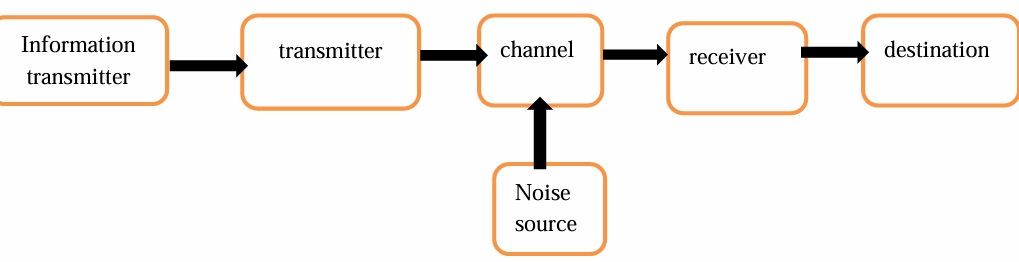
Block diagram of communication system
Communication system is a system model describes a communication exchange between two stations, transmitter and receiver. Signals or information passes from source to destination through what is called channel, which represents away that signal use it to move from source to ward destination.to transmit signals in communication system, it must be first processed by several stages, beginning from signal representation, to signal shaping until encoding and modulation. After preparing the transmitted signal, it passed to the transmission line of channel and due to signal crossing this media it faces many impairments such noise, attenuation and distortion. Based on the medium they used communication system broadly classified in to two. These are wired communication system and wireless communication system.
Wireless communication is one of the most active areas of technological development. This development is being driven primarily by the transformation of what been a medium for supporting voice telephony into a medium for supporting other services such as transmission of video, images, text, and data e.t.c. basically communication system deals witch information or data transmission from one point to another.
Wired communication is referring to transmission of data over a wire based Examples include telephone networks, cable television or internet access, and fiber-optic communication. Also waveguide (electromagnetism), used for high-power applications, is considered as wired line. Local telephone networks often form the basis for wired communications that are used by both residential and business customers in the area. Most of the networks today rely on the use of fiber optic communication technology as a means of providing clear signaling for both inbound and outbound transmissions
A communication channel or simply channel refers either to a physical transmission medium such as a wire, or to a logical connection over a multiplexed medium such as a radio channel in telecommunications and computer networking. A channel is used to convey an information signal, for example a digital bit stream, from one or several senders or transmitters to one or several receivers. A channel has a certain capacity for transmitting information, often measured by its bandwidth in Hz or its data rate in bits per second.
Communicating data from one location to another requires some form of pathway or medium. These pathways, called communication channels, use two types of media: cable (twisted-pair wire, cable, and fiber-optic cable) and broadcast (microwave, satellite, radio, and infrared). Cable or wire line media use physical wires of cables to transmit data and information. Twisted-pair wire and coaxial cables are made of copper, and fiber-optic cable is made of glass.
A wireless network enables people to communicate and access applications and information without wires. This provides freedom of movement and the ability to extend applications to different parts of a building, city, or nearly anywhere in the world. Wireless networks allow people to interact with e-mail or browse the Internet from a location that they prefer.
Fading effects of wireless channel
In wireless communications, fading is variation of the attenuation of a signal with various variables. These variables include time, geographical position, and radio frequency. Fading is often modeled as a random process. A fading channel is a communication channel that experiences fading. In wireless systems, fading may either be due to multipath propagation, referred to as multipath-induced fading, weather (particularly rain), or shadowing from obstacles affecting the wave propagation, sometimes referred to as shadow fading.
The presence of reflectors in the environment surrounding a Transmitter and receiver create multiple paths that a transmitted signal can traverse. As a result, the receiver sees the superposition of multiple copies of the transmitted signal, each traversing a different path. Each signal copy will experience differences in attenuation, delay and phase shift while traveling from the source to the receiver. This can result in either constructive or destructive interference, amplifying or attenuating the signal power seen at the receiver. Fading may be large scale fading or small scale fading. Based on multipath time delay spread small scale fading is classified as flat fading and frequency selective fading. If bandwidth of the signal is smaller than bandwidth of the channel and delay spread is smaller than relative symbol period then flat fading occurs whereas if bandwidth of the signal is greater than bandwidth of the channel and delay spread is greater than relative symbol period then frequency selective fading occurs. Based on Doppler spread small scale fading may be fast fading or slow fading. Slow fading occurs when the coherence time of the channel is larger relative to the delay constraint of the channel. The amplitude and phase change imposed by the channel can be considered roughly constant over the period of use. Slow fading can be caused by events such as shadowing, where a large Obstruction such as a hill or large building comes in the main signal path between the transmitter and the receiver. Fast fading occurs when the coherence
time of the channel is small relative to the delay constraint of the channel. The amplitude and phase change imposed by the channel varies considerably over the period of use. In a fast-fading channel,
the transmitter may take advantage of the variations in the channel conditions using time diversity
to help increase robustness of the communication.

Fading effects comparison
Fading types
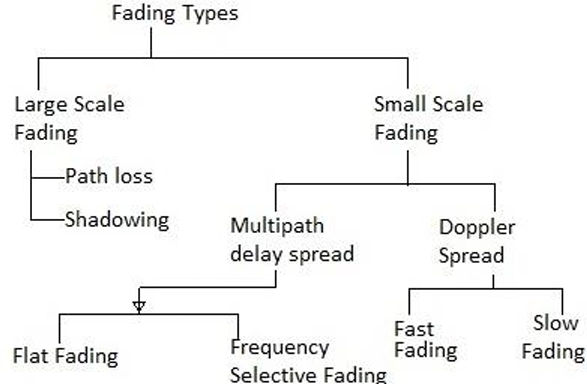
Classifications of fading effect
Large scale fading of wireless channel
Large scale fading occurs when an obstacle comes in between transmitter and receiver. This interference type causes significant amount of signal strength reduction this is because EM wave is shadowed or blocked by the obstacle. It is related to large fluctuation of the signal over distance.